
Choosing a stove can be difficult. None of the camping stoves we have reviewed could be described as poor. How then do you decide which stove is best for you? That depends on several factors. How many people will it be used for? A stove for several people needs to support big pots. A stove for solo use can be minimalist and ultralight. When will the stove be used? All stoves work fine in warm weather. Not all work well in the cold. Which fuel is best? For short trips where it will all be carried from home this doesn’t matter. For longer trips you need to know what fuel will be available along the way. Fuel efficiency matters as well – the better it is the less often you’ll need to resupply. Do you just want a stove to boil water or one that simmers so you can do some real cooking? Not all stoves have easily controlled flames.
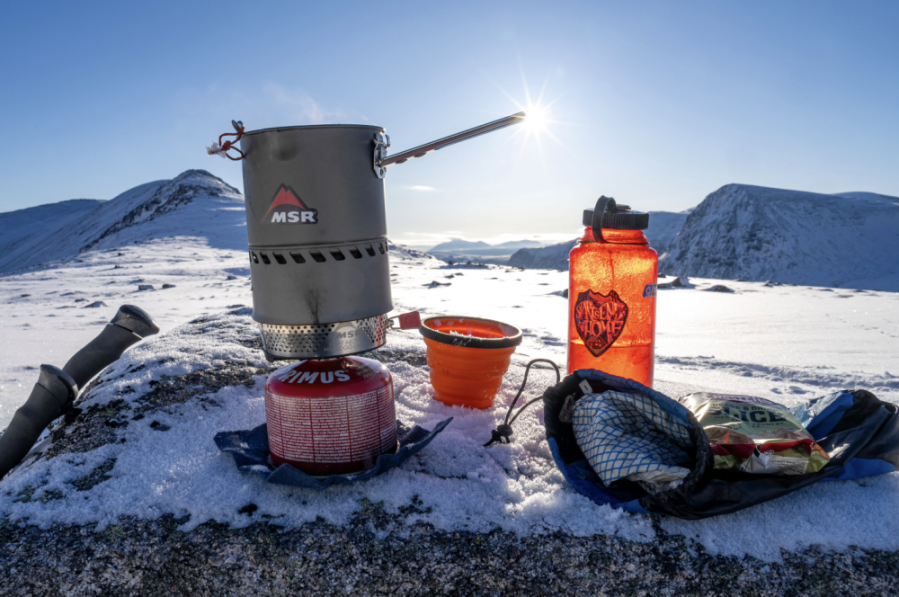
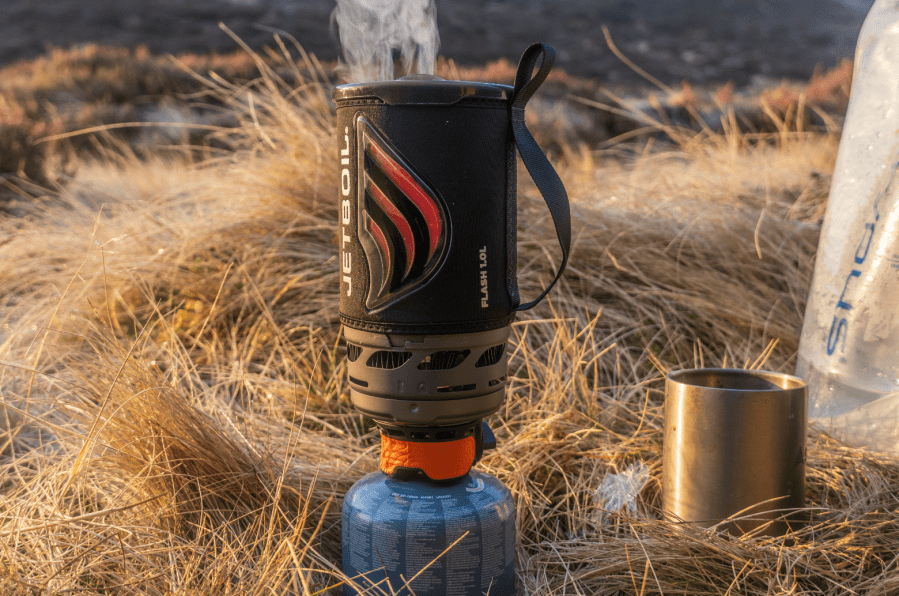
Main image: Stove system in the winter cairngorms | Credit: David Lintern
With any stove you need a pot or two. Some models come with pots, and they’re often designed to work together as a system. If you don’t already have any pots one of these could be a good choice.
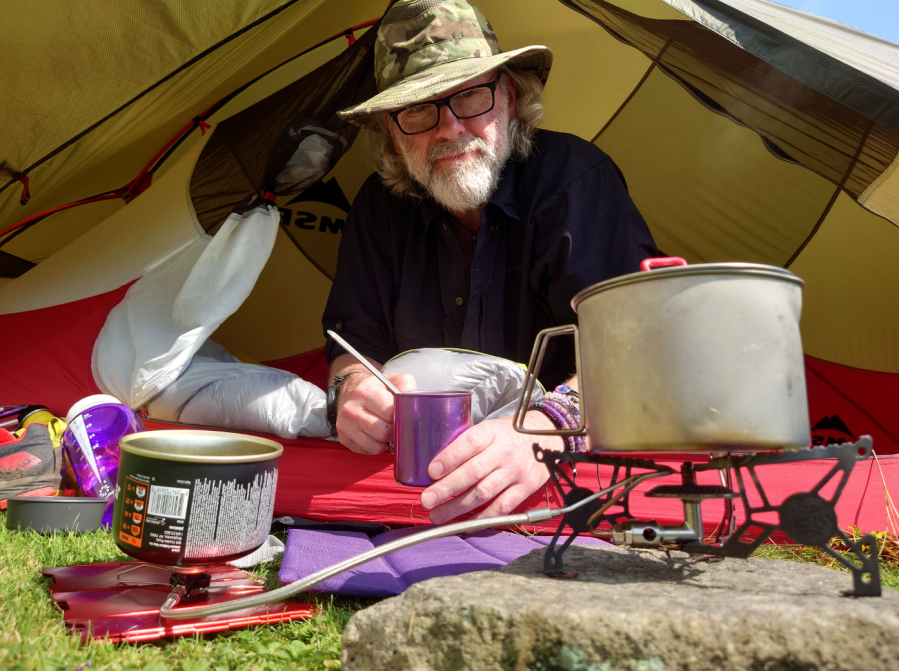
Fast boil times sound impressive. However running a stove at full power isn’t best for fuel efficiency. Turning the stove down a little and waiting a minute or two for your tea or coffee saves fuel. Other simple ways to reduce fuel use are to have a lid on the pot and to use a windscreen. Heat exchanger pots also make a big difference.
Whichever stove you choose it’s always best to practise with it at home rather than trying to work out how to light it on a windy hillside. Stoves are potentially dangerous so knowing how to operate one safely is essential.
What camping stove you choose depends on where you plan to go with it, in what conditions, and how you use your hot water. That and your budget – there’s a wide range of prices here too. Looking for advice for maintaining a stove? Our guide on how clean a camping stove will help you there.
Why you can trust The Great Outdoors
The Great Outdoors is here to help you make the most of your time outside. We have been helping people to explore from sea to summit, valley to mountain top for over 40 years. Our gear tests remain completely impartial. If you are wary of websites that only review brands that advertise with them, or sceptical of social media accounts always singing the praises of their latest freebie, you’ve come to the right place! Our reviews rank #1 for rigour, trustworthiness, and independence, and our gear testing team is the most experienced in Britain. With over 200 years’ experience between us, we are professional mountain leaders and instructors, wildlife photographers and rangers, outdoor authors, guidebook writers and trail addicts.
The best camping stoves we’ve tested
| Quick List |
|---|
| Gear of the Year Award Winner: Optimus Vega (available from Base Camp Food) |
| Greener Choice: Alpkit MyTiBurner (available from Alpkit) |
| Best all-season efficiency: SOTO Fusion Trek (available from Ellis Brigham) |
| Lightest in test: Primus Micron III (available from WildBounds) |
| Low profile: Fire Maple Petrel Titanium Ultralight (available from Fire Maple) |
| Best boil time: JetBoil Flash 1L (available from Base Camp Food) |
| Best for windy conditions: MSR Reactor 1L (available from alpinetrek.co.uk) |
| Best value: Campingaz Twister Plus PZ (available from Go Outdoors) |
| Best for basecamp: Primus Tupike (available from alpinetrek.co.uk) |
Gear of the Year Winner
Optimus Vega
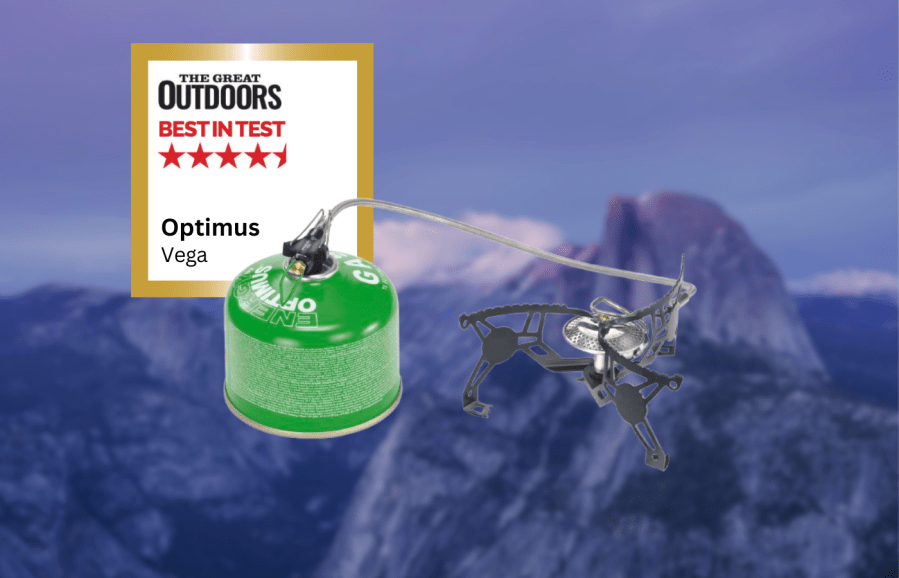
Peter Macfarlane’s Best in Test
It’s very light, folds aways small, and its stability and wide burner make it the best I’ve tested for real cooking.- stable
- adaptable
- winter performance
- the pot rests could be less steeply angled
| Quick specs |
|---|
| Price: $119.95 / £89.95 (available from Base Camp Food) Weight: 185g Fuels: gas canister Dimensions assembled 74mm h x 160mm Ø Burner Diameter: 48mm Power: 2600W Boil time: 3m10s x 500ml Fuel used: isobutane/propane canister katadyngroup.com |
The Optimus Vega is a remote canister stove suitable for year-round use. It has a preheat tube running over the burner that vaporises the gas, which means it can be used as a liquid fuel stove in subzero temperatures by inverting the canister. Unusually, it has flip-out wire legs to hold the inverted canister in place and enable the control lever to still be used. Optimus says that used like this it’ll work down to -20°C.
The Vega is compact when packed as the pot support/legs fold around the burner. At 178g it’s light for a remote canister stove. It has a low profile so stability is good and the pot supports are quite wide, making it fine for use with big pots. The burner is powerful and it boils water fast and works well for melting snow. Flame control is good for simmering. It’s fuel efficient too, though fuel usage increases when the canister is inverted so this should only be done when necessary. The Vega comes with a foil disc to place under it to prevent it scorching the ground, but not a windscreen, which is needed in strong winds. One is available separately, the Optimus Wind Foil, which weighs 36g and costs £7.70. The Vega itself costs £139.99. Tester Peter Macfarlane says “the Vega is excellent – a reliable go-to and brilliant in the tent porch.”
Read more: Peter’s full Optimus Vega review
Low profile
Fire Maple Petrel Titanium Ultralight
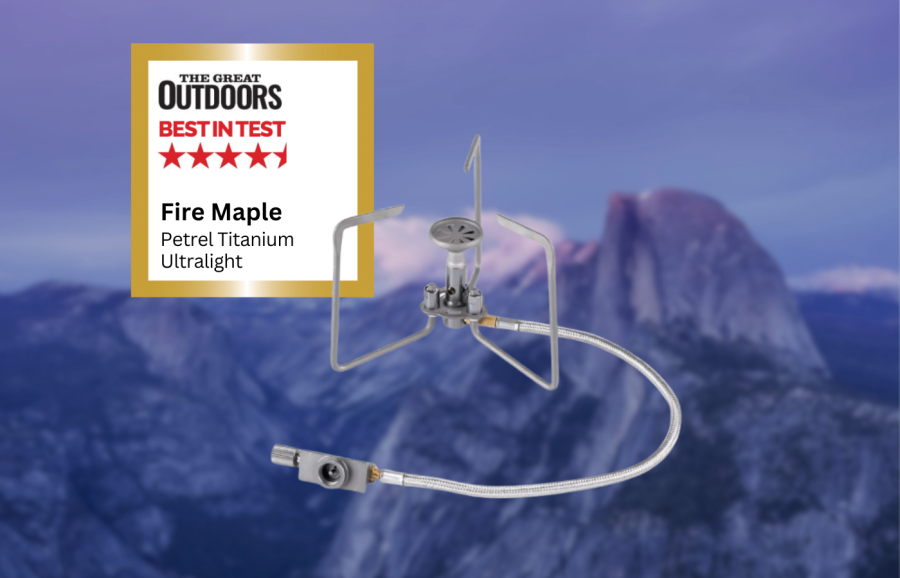
Chris Townsend’s Best in Test
Overall, this is a lovely little stove that has quickly become a favourite.- ultralight
- low profile
- compact
- stable
- cost
- no pre-heat tube
| Quick Specs |
|---|
| Price: $31.96 | £43.34 (available from Fire Maple) Weight: 96g, 116g with windscreen Fuels: butane/propane Dimensions: packed 30mm x 100mm Burner Diameter: 25mm Power: 2.7KW, 9213 BTU Boil time: titanium pot 7min 10 sec, HX pot 5 min 10 sec Fuel used: titanium pot 11g, HX pot 6g firemaplegear.com |
The Fire Maple Petrel is a very light remote canister stove – the only one I know of weighing under 100 grams. It has a long hose to attach to the canister, which makes for a low profile and good stability. The burner can also be completely surrounded by a windshield (but note that the supplied one only wraps about two-thirds of the way). The low profile is good for cooking in small tent porches as well as being more stable than a canister top stove, especially with wider pots. It’s a neat little stove with combined legs/pot supports that fold flat and compact when not in use. The hose swivels under the burner so the canister can be moved with the stove lit. The flame control is on the canister not the stove so there’s no danger of burning your fingers when adjusting the flame. The burner is powerful and boils water fast. It simmers well too, though as with all remote stoves there’s a slight lag between turning the control and the flame changing.
Read more: Chris’ full Fire Maple Petrel review
Best all-season efficiency
SOTO Fusion Trek
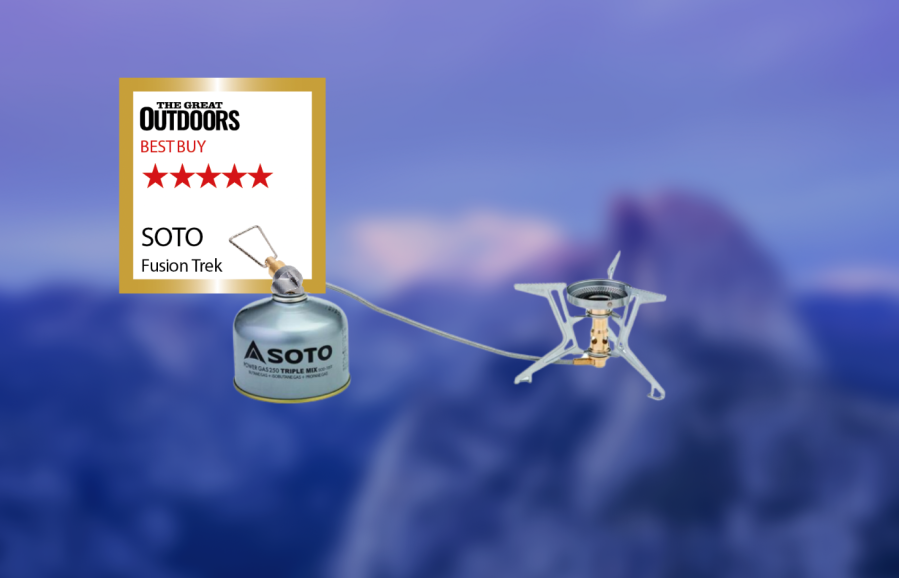
David Lintern’s Best in Test
It’s super-stable and all-season-capable, and is built to last. It can simmer, not just nuke, water; it can cook for one or for five; and it’s economical to run.- all-season remote canister design
- fuel efficiency
- price
- slightly bulkier than other options
- pan and windshield not included
| Quick specs | |
|---|---|
| Price: $84.95 / £65 (available from Ellis Brigham) Weight: 186g Type: Pressure-regulated remote-canister stove Fuel: Gas Dimensions: 11x6x10cm Burner diameter: 6cm Power: 3260W / 11000BTU Boil Time Average: 4min on test Burn Time Approx: 90min from a 230g canister (quoted) sotooutdoors.com |
In brief and for those who don’t know the brand, The SOTO Fusion Trek camping stove is a remote-canister version of the well regarded Windmaster stove. There’s a fairly wide burner, with around 300 burn holes sitting in a concave circular ‘tray’ and surrounded by a lip of metal. The three legs extend very securely, and the pot supports are integral to the legs, making for a very stable base. The hose to the canister is very flexible, which may sound trivial, but if you’ve ever wrestled a stiff fuel hose and a windshield together in the cold, you’ll realise how useful this is. Even the canister attachment is well-designed and has a wired hoop control for fine flame control at the canister end.
The Fusion Trek gets my Best Buy because of its versatility. It’s super-stable and all-season-capable, and is built to last. It can simmer, not just nuke, water; it can cook for one or for five; and it’s economical to run.
Read more: David’s full SOTO Fusion review
Best wind resistance
MSR Reactor 1L
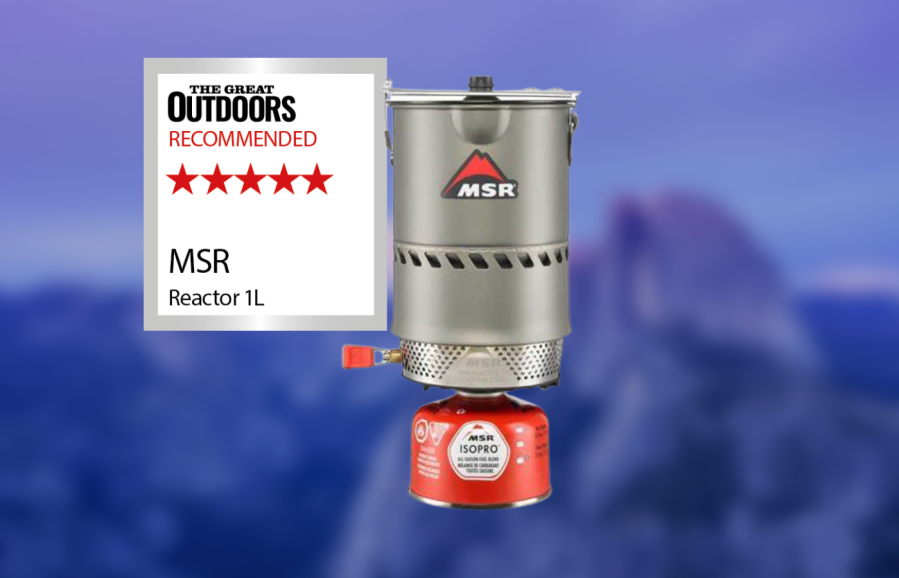
David recommends
It is a one-trick pony and expensive, but it is perfect for short, sharp missions to the mountains, especially in winter.- Rapid boil
- Excellent wind resistance
- Compact
- No simmer capability
| Quick specs | |
|---|---|
| Price: $270 | £295 (available from alpinetrek.co.uk) Weight: 432g Type: pressure-regulated, radiant burner stove system with integrated pan and heat exchanger Fuel: gas Dimensions: 12×14.5cm Burner diameter: 10cm Power: 9000W / 3070BTU Burn time: approx 80min from a 230g canister (quoted) |
The Reactor is a high-performance camping stove designed to melt snow and boil water quickly. It is wind-resistant and uses both convective heat and radiant light energy. It has a solid, all-metal handle that stays cool to the touch and folds away securely over a pot lid with a strainer and steam release. The pressure regulator gives an even burn and it was the only stove on test to beat its quoted boil times. It is a one-trick pony and expensive, but it is perfect for short, sharp missions to the mountains, especially in winter.
Read more: David’s full review on the MSR Reactor 1L
Jetboil Stash
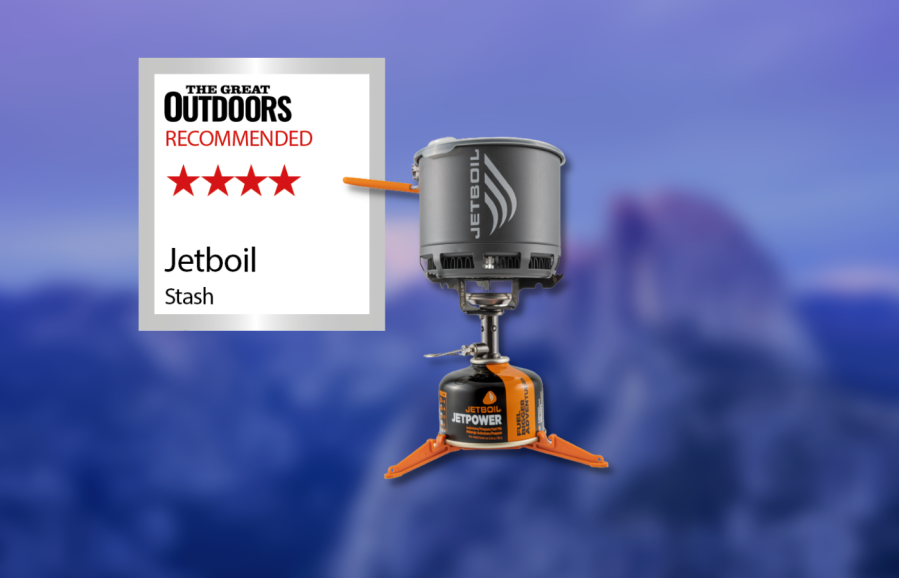
David Lintern recommends
There’s a lot to like here. It’s a simple, very light design that packs small and will allow basic cooking.- Weight
- Compact size
- Reasonable Simmer control
- No wind resistance without a windshield (not inlcluded)
- No pressure regulator
| Quick specs | |
|---|---|
| Price: $127.95 | £155 (available now from alpinetrek.co.uk) Weight: 232g including burner, pot and canister stand (24g) Type: Unregulated pressure canister-top stove system with integrated pan and heat exchanger Fuel: Gas Dimensions: Pot 0.8 Litres, 10x12cm Burner diameter: 4cm Power: 1318W/ 4500BTU Boil time: Average 5min on test Burn time: Approx 80min from a 230g canister (quoted) |
The Jetboil Stash camping stove was big news when unveiled a year or two ago as the lightest in the range. It achieved the 200g-ish all-in weight by dumping some of the features found on larger and heavier models. The Stash too is a ‘stove system’, but it’s really packable. The 0.8 litre pot is wide rather than tall, making it less prone to burning food and easier to stir the contents. It’s more than big enough for most solo meals (and will hold a 100g canister if you wish). There’s a very solid integrated handle that folds over the plastic lid, which has a built-in drainer.
There’s a lot to like here. It’s a simple, very light design that packs small and will allow basic cooking. For longer, warmer-weather trips nothing else is needed.
Read more: David Lintern’s full review of the Jetboil Stash
Lightest in test
Primus Micron III
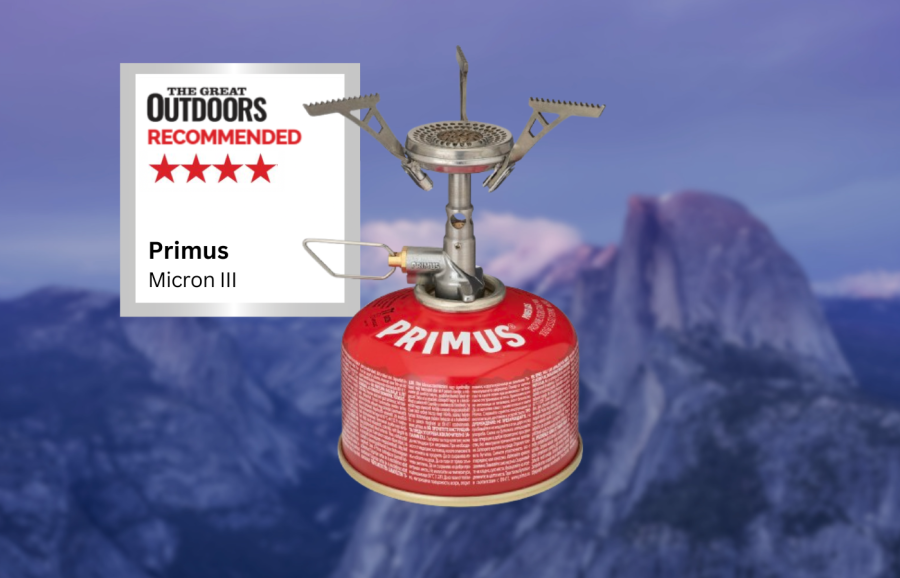
Chris Townsend recommends
A powerful, ultralight three-season stove with good flame control.- good flame control
- fuel efficient
- compact
- ultralight
- powerful
- not regulated
- poor wind-resistance
| Quick Specs |
|---|
| Price: $69.99 | £60 (available from WildBounds) Weight: 58g Fuels: gas canister Dimensions: 80 x 110mm open, 62 x 41mm folded Burner Diameter: 38mm Power: 2600 watts/ 8900 BTU Boil time: average 2 min 45 sec for 500ml water Fuel used: 6 – 7g www.primusequipment.co.uk |
The latest version of Primus’s Micron stove, which has been around in different models for over twenty years, is the lightest, just 58g, and most compact yet. While the Primus Micron III is tiny folded up, it has wide pot supports and a long control handle that’s easy to use with gloves and prevents burnt fingers. The pot supports have serrated edges to hold pots securely and click into place when unfolded. The burner has a narrow flame and a mesh centre that glows red. Flame control is good so food can be simmered.
In calm controlled conditions the Micron took 3 minutes to boil 500ml of water in an MSR Titan 900ml titanium pot and 1 minute 45 seconds in a Fire Maple Petrel G2 aluminium heat exchanger pot, using 7 and 6 grams of fuel respectively. In real world use a Primus Power Gas 100g canister lasted 4 days with the stove, boiling around 4.5 litres in a heat exchanger pot before it was empty.
Read more: Chris’ full Primus Micron III review
Best boil time
Jetboil Flash 1L
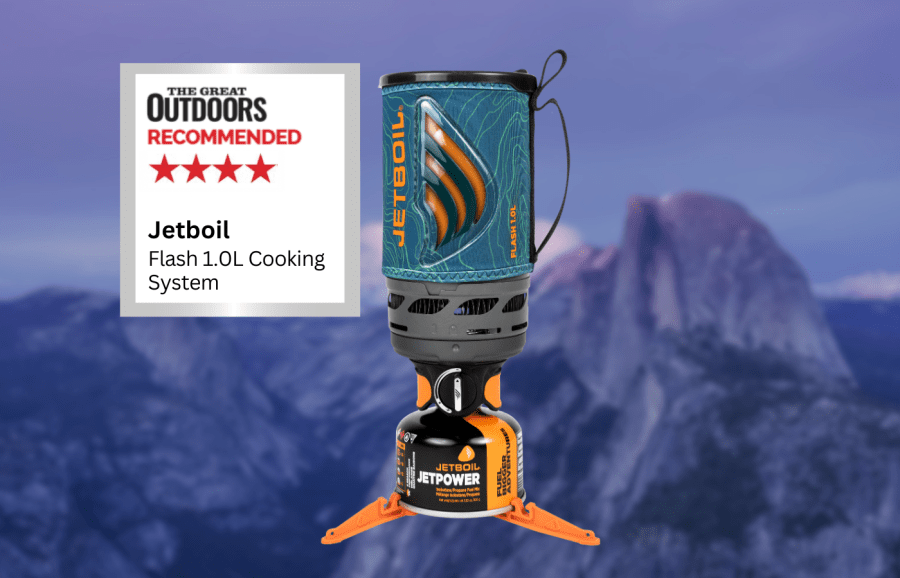
Chris Townsend recommends
For boiling water for hot drinks and cook-in-the-pouch meals it works fine. The price is low for a stove system, making the Flash good value for money.- fast boil time
- fuel efficiency
- heat exchanger pot
- ease of use
- price
- unregulated burner
- simmering difficult
- not fully windproof
| Quick Specs |
|---|
| Price: $144.99 | £100.59 (available from Base Camp Food) Weight: 406g complete Accessories: 0.6 litre pot with heat exchanger & insulated pot cozy, 0.3 litre bowl, piezo igniter, canister stand Fuel: butane/propane canister Packed Dimensions: 18.5 x 10.7cm Burner Diameter: 3.8cm Burner weight: 124g Power: 5300 BTU Boil time: 2 min 36 seconds Fuel used: 8g www.jetboil.co.uk |
Twenty-one years ago, Jetboil launched the first ever stove with a heat exchanger pot that fitted onto the burner. The Jetboil Flash 1.0L Cooking System is the direct descendant of that stove and has been popular for many years. Jetboil has updated the design with several significant changes to make it easier to use, the main ones being an integrated ignition and burner control and a grip zone below the burner. The pot is the same tall narrow aluminium one with a pot cosy round it, a thermochromic heat indicator on the side, a webbing handle, and a plastic lid. The heat exchanger under the pot now has three rather than two dimples for attaching it to the burner to give a firmer fit plus markings showing which way to turn the pot to release it from the burner.
The Flash boils water fast and is fuel efficient. My most severe test of the Flash was on a camp where the temperature fell to -2°C overnight. The stove was used with a half-full canister that had been on the ground all night. It lit immediately and boiled 400ml of water in three minutes, which I think is fine. There was a slight breeze, which didn’t affect the flame. The new Flash is an improvement over the previous model. The grip zone and turn-and-click ignition are excellent. It’s great being able to hold the stove securely while switching it on or putting on and taking off the pot. For boiling water for hot drinks and cook-in-the-pouch meals it works fine. The price is low for a stove system, making the Flash good value for money.
Read more: Chris’ full Jetboil Flash 1L Cooking System review
Alpkit Koro

David Lintern recommends
I like the Alpkit Koro enough to own one; I bought and paid for the unit on test. It’s simple, light, packs down small and is inexpensive.- inverted canister all-season use
- suits variety of pots
- price
- marginally less efficient than other comparable stoves on test
- pan and windshield not included
| Quick specs | |
|---|---|
| Price: £41 Weight: 126g Type: Pressure-regulated remote-canister stove with preheat tube Fuel: Gas Dimensions: 8x8x9cm Burner diameter: 8cm Power: 2800W / 9553BTU Boil time Average: 5min on test Burn time Approx: 70min from a 230g canister (quoted) www.alpkit.com |
The Alpkit Koro has three legs and three pot supports. The Koro is pretty powerful, but there are faster units out there. The burner has no inherent wind resistance other than it being close to the ground, and so a half-height windshield is essential. Similarly, simmer control is OK, but not world-beating. The ability to invert the canister in colder temperatures or when near the end of the canister is really useful.
I like the Alpkit Koro enough to own one; I bought and paid for the unit on test, last year. It’s simple, light, packs down small and is inexpensive. There are other options here that will boil faster using less gas, and I’d prefer the pot supports to be a little more robust; but the Koro operates on a principle of good enough – and most of the time it’s just that.
Read more: David’s full Alpkit Koro review
MSR Switch Stove System

Chris’ verdict
Overall, the Switch is an efficient system with an interesting and unusual pot. It’s not the lightest option but the price is reasonable.- Regulated burner
- Fast boil time
- Pot design
- Tall & narrow pot
- Not that light
| Quick Specs | |
|---|---|
| Price: $139.95 / £135 (available from Cascade Designs) Weight: 389g complete, burner & pot w/out accessories 328g Fuel: isobutane/propane Dimensions: stove 9.4 x 8.4cms, pot 17.7 x 11cms Burner Diameter: 2.8cms Power: 7100 BTU, 2100W Boil time: 2 minutes 45 seconds Fuel Used: 10 grams www.msrgear.com |
The latest combined stove and pot system from MSR – the MSR Switch Stove System – has a unique design unlike anything I’ve seen before. It’s very different to MSR’s other stove systems, the well-established Reactor and Windburner, which have radiant burners and can only be used with compatible heat exchanger MSR pots. The lighter weight Switch has a standard burner and is more versatile as it can be used with any pots. The cost is also much lower.
Read more: Chris’ full MSR Switch Stove System review
Best for basecamp
Primus Tupike
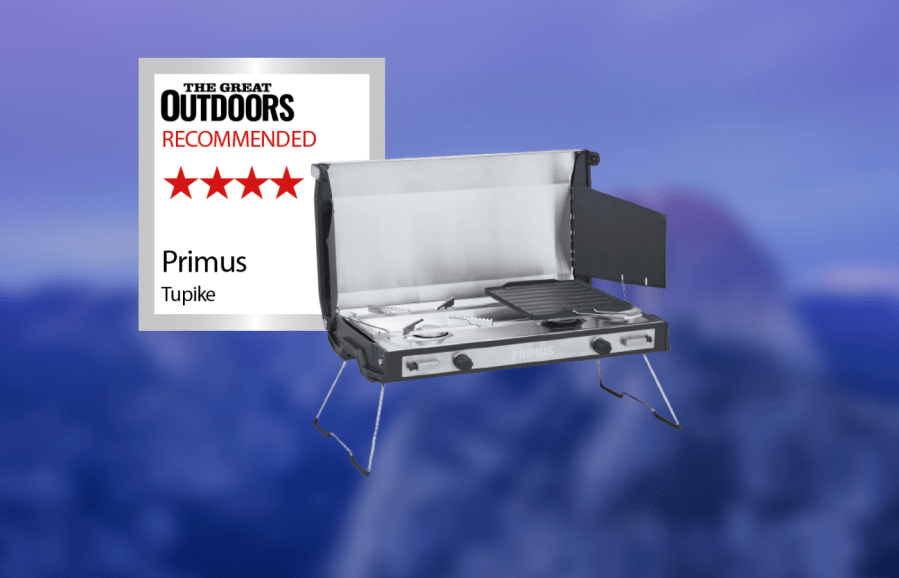
David recommends
The Tupike is a two burner camping stove desgined for basecamps and backpacking, it is large and heavy but beautifully finished and is a bit of a gas guzzler.- Genuine simmer-capable cooking stove
- Made to last
- Thirsty on fuel
| Quick specs | |
|---|---|
| Price: $260 | £240 (available from alpinetrek.co.uk) Weight: 4.3kg Type: Pressure-regulated dual burner base camp stove Fuel: Gas Dimensions: 8x48x30cm Burner diameter: 4.6cm Power: 3000W / 1023BTU Boil time: average 5min on test Burn time: approx 47min from a 230g canister (quoted) |
The Tupike is a two-burner camping stove designed for basecamps and backpacking. It has two independent burners, two piezo igniters and two flame controls, and a griddle. It is large and heavy, but is also beautifully finished in brass, oak and brushed aluminium. It sits on two locking and folding legs and has adjustable windshields and a splashback. However, its fuel efficiency is a bit of a gas guzzler, so it should be used with larger canisters and boil/rest cycles to conserve fuel.
Read more: David’s full review on the Primus Tupike
GSI Pinnacle Four Season
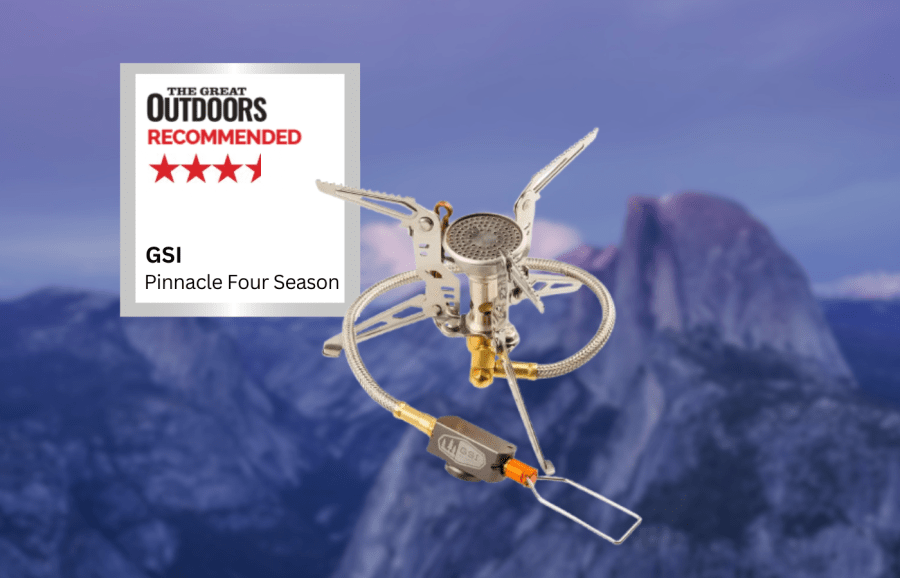
Chris Townsend recommends
The Pinnacle is a good stove for year-round use. There are lighter options for three-season use only, but it’s not heavy for a remote canister stove.- pre-heat tube
- low profile
- stable
- compact
- fiddly to set up
- no windscreen
| Quick Specs |
|---|
| Price: $109.95 | £99.99 (available from WildBounds) Weight: 163g Fuels: butane/propane Dimensions: packed 50mm x 80mm Burner Diameter: 30mm Power: 9820 BTU Boil time: titanium pot 9 min 8 sec, HX pot 5min 55 sec Fuel used: titanium pot 11g, HX pot 5g gsioutdoors.com |
It has a powerful burner that boils water fast. Surprisingly it’s quieter than the other two canister stoves tested here, though it still roars. When packed, it’s very compact with the legs and pot supports folding neatly round the burner. Setting up and taking down is a little fiddly – both legs and supports have to be opened in a specific sequence with three actions needed for each set. Once learned it can be done quite quickly but it’s not the simplest system.
Once set up the Pinnacle works well. The low profile means its stable and the serrated supports hold pots firmly. The burner simmers well, with the usual slight lag in the flame adjustment when you turn the valve as the latter is situated on the canister not the burner. The long wire control is easy to use with an upright canister, though more awkward when its inverted. There’s no Piezo igniter, so a lighter or fire steel is required. Unlike many remote stoves the Pinnacle, doesn’t come with a windshield and one is needed as the burner has no protection. Suitable foil ones are easily available and inexpensive, but I would like to see one supplied.
Read more: Chris’ full GSI Pinnacle Four Season review
Robens Fire Wisp Solo Cook Set UL
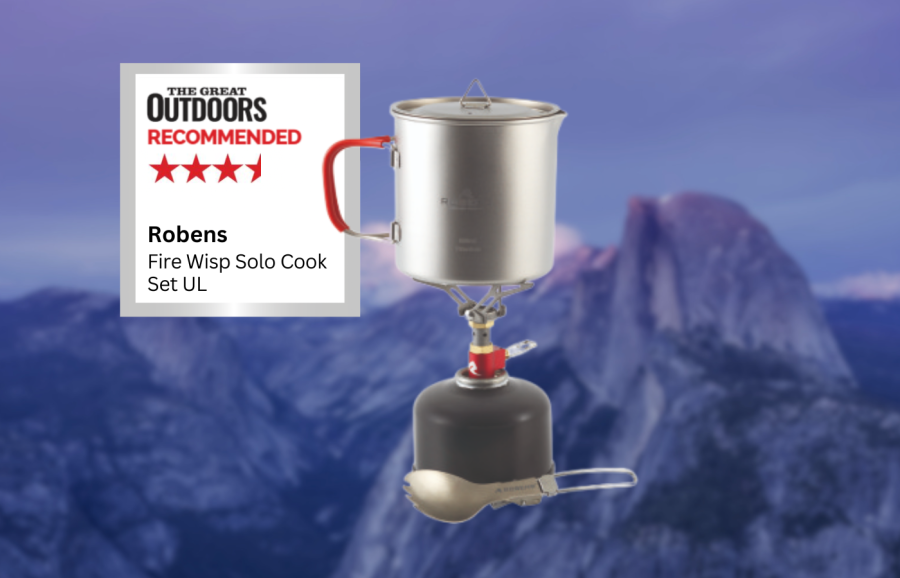
Chris Townsend Recommends
For weight conscious hikers and bikepackers, I think it’s a great choice.- tiny burner
- compact
- ultralight
- not regulated
- unstable with big pots
- no windscreen
| Quick Specs |
|---|
| Price: £75 (available from liGo) Weight: burner 45g, complete with mug & spork 163g Fuels: butane/propane Dimensions: burner 50mm x35mm, complete 105mm x 100mm Burner Diameter: 20mm Power: n/a Boil time: 6 min 34 sec Fuel used: 9g robens.de |
The Robens Fire Wisp Solo Cook Set pairs the Robens Fire Midge titanium canister top stove with a 650ml titanium mug and a folding titanium spork to make a practical set for solo users. The stove is tiny but surprisingly powerful – and noisy! It combines well with the mug. Anything wider is less stable as the pot supports are quite short. The stove, spork, and a 100 size canister all fit neatly inside the mug. The mug is an ideal size for solo use. It has insulated fold-out handles and a pour spout. The lid has a tiny handle that folds up. This can get hot. There’s a small hole for steam, which can also escape through the spout.
The spork is foldable, so it also inside the pot. In use, the stove boils water fast. The flame can also be turned down for simmering, though care is needed doing this as the wire control is short and close to the burner. The burner has no wind protection and becomes ineffective in anything above a light breeze. A windshield is essential. Robens offers a foil one weighing 64 grams and costing £7. Of course, because this is a canister top stove, the user must take care not to completely surround the burner, so the gas canister doesn’t get hot.
Read more: Chris’ full Robens Fire Wisp Solo Cook Set review
Best value
Campingaz Twister Plus
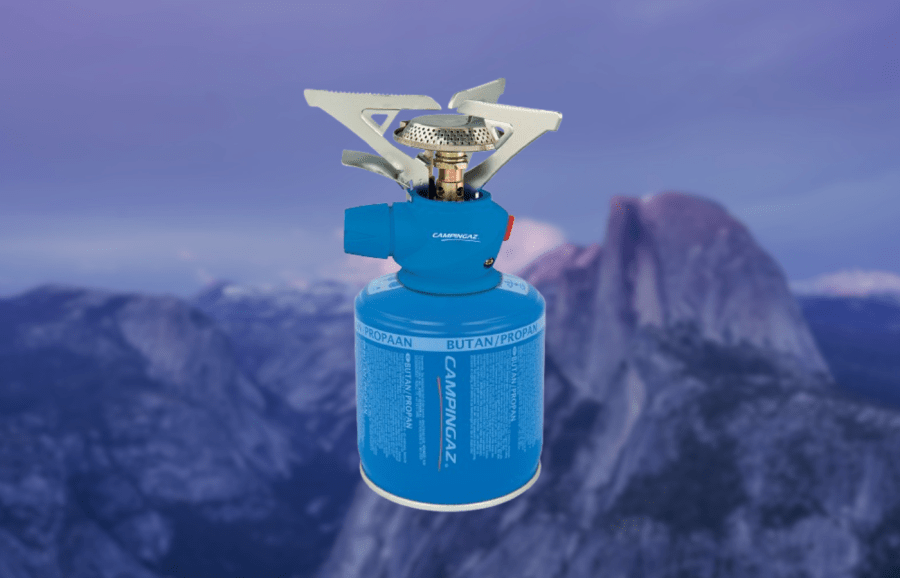
Peter Macfarlane’s Best Value
It might be a little heavy and bulky but is an accessible starter stove that you really can really cook on.- simple and easy to use
- cheap
- heavy
- limited to CG gas without adaptor
| Quick Specs |
|---|
| Price: no US shipping | £24.99 (available from Go Outdoors) Weight: 210g (burner only) Fuels: bespoke gas canister Dimensions assembled 110mm h x 120mm w Burner Diameter: 54mm Power: 2900W Boil time: 2m40s x 500ml Fuel used: butane/propane canister www.campingaz.co.uk |
I’ve had many Campingaz stoves over the years. A twin burner model was a favourite for many years, so I was very curious to see how their current dedicated mountain style stove compared. The Campingaz Twister Plus PZ Gas Stove is used with Campingaz’s own widely available gas canisters of various sizes. It ends up quite tall, but still stable enough even without a dedicated pot stand, partly because canister and burner together are weightier. 3rd party plastic canister feet will fit. The stove design is chunky with the metal burner parts encased in a plastic surround incorporating both piezo and control dial. The shape means a good grip for attaching the canister – a push-on and quarter turn with a click and the reverse action for removal. It’s a good system, with a definite click that reduces the likelihood of over overtightening. There are adapters to bridge the gap between Campingaz connections and other canisters.
The fine-tuning heat is positive and smooth. Nice touches are a metal heat shield between the burner control, a hard plastic case and of course the price. It might be a little heavy and bulky but is an accessible starter stove that you really can really cook on.
Read more: Peter’s full review of the Campingaz Twister Plus PZ
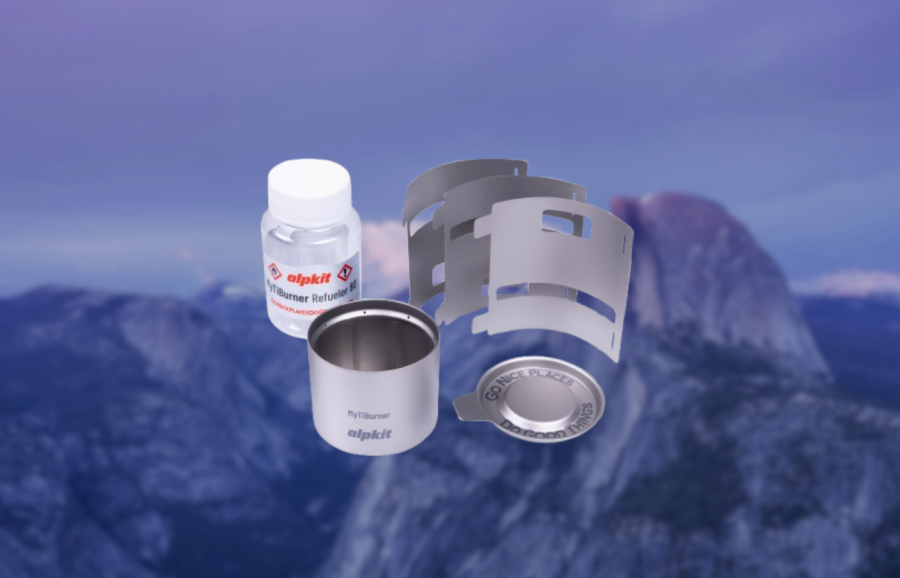
Alpkit MyTiBurner
Chris Townsend’s Greener Choice
The unit is lightweight, very compact and simple to use. For solo use, especially for those who only want a stove for boiling water, it could be a good choice.- lightweight
- compact
- silent
- non-petroleum fuel
- only suitable with very small pots
- not that easy to light
| Quick Specs |
|---|
| Price: £47.99, £77.98 with MyTiMug 400 (available from Alpkit) Weight: burner 88g, with MytiMug 400 173g Fuels: bioethanol, methylated spirits Dimensions: packed 75mm x 80mm Burner Diameter: 6cm Power: n/a Boil time: 12 min 30 sec Fuel used: 40ml alpkit.com |
The Alpkit MyTiBurner is a little alcohol burner with a curved windshield pot support, both made of titanium. The windshield comes in three pieces that slot together and fit closely round the burner.
The stove is easy to set up, but it needs level ground to keep the pot stable. The burner is deep and there’s not much of a lip to collect fuel for priming. I found it has to be tipped if using a lighter, and long matches work better. The windshield works okay in gentle breezes but in strong winds, flames come out of the slots in the sides and fuel consumption and boiling time increases. Boiling times are long compared with canister stoves and there’s no flame control. However, the unit is lightweight, very compact and simple to use. For solo use, especially for those who only want a stove for boiling water, it could be a good choice.
Read more: Chris’ full Alpkit MyTiBurner review
How we test these camping stoves
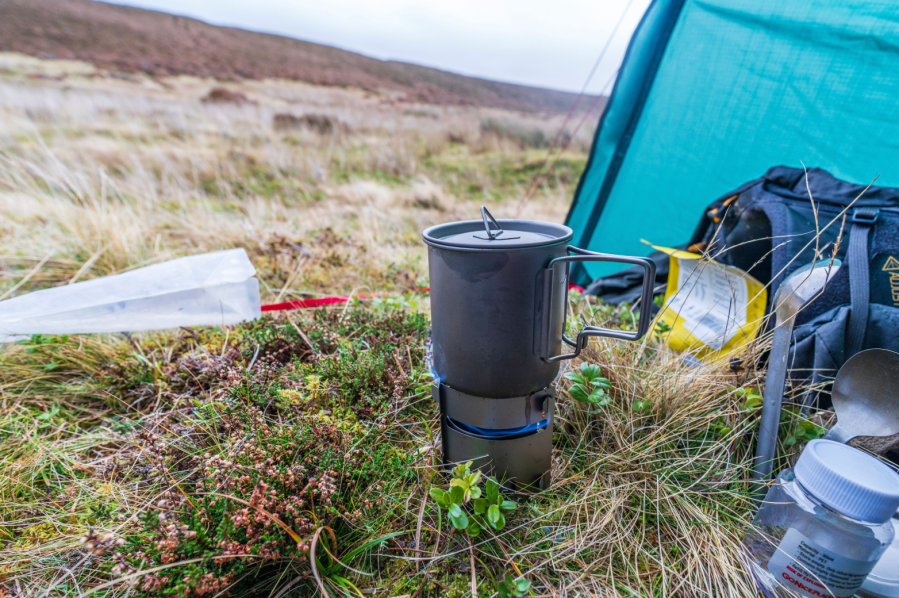
In controlled conditions in still air Chris boiled 500ml of water in each stove with a standard pot and a heat exchanger pot. Boiling times indicate the power of the stove. In cold weather, especially when melting snow, this can be important. He also measured how much fuel was used, which is more significant than boiling time, especially on multi-day walks. The results show that HX pots are more fuel efficient and reduce boil times with all stoves.
Go System 2250 canisters were used with the gas stoves, Bartoline methylated spirits with the Trangia and Alpkit Bruler stoves. For stoves that don’t come with pots Chris used 1 litre hard anodised aluminium pots – the GSI Pinnacle Soloist and Fire Maple FMC-XK6 HX. In field use several variables – air temperature, water temperature, wind speed and more – will produce different results so these figures are comparative only.
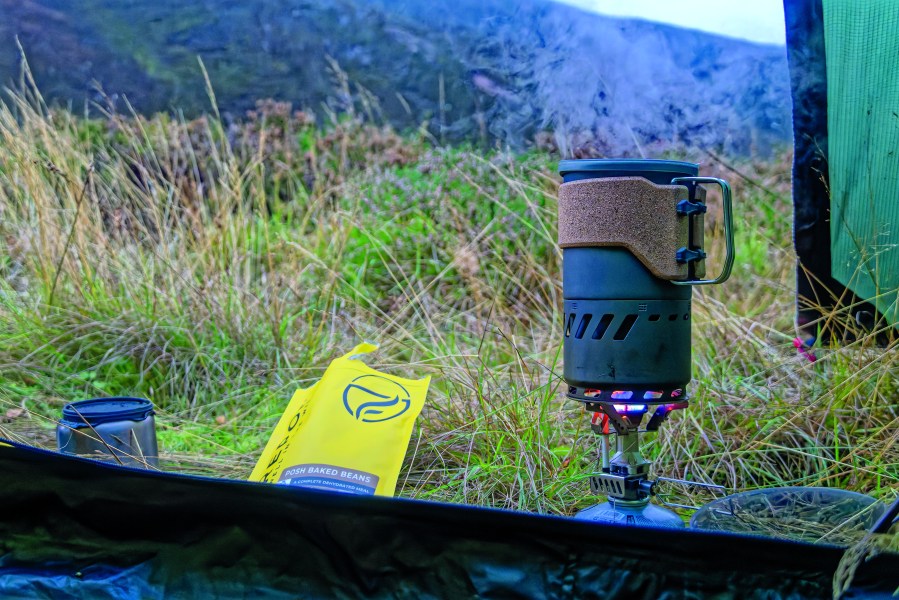
David tested his stoves on walks and backpacks from glen level to Munro summits across the eastern and western Highlands in 2024. It was winter on the tops and spring in the glens. He tends to boil water for dehydrated meals, but his budget is supermarket rather than branded outdoor sachets. As such, his food needs longer to hydrate and he does a little more in-pot preparation, rather than just pour-and-wait. This makes a difference to what he looks for in a stove.
Measuring stove performance is as hard as or harder than evaluating sleeping bags as there are so many variables – “but at least I was able to drink lots of tea as I tested,” he said. When deciding on a purchase, it’s worth looking closely at the power output and burn times in conjunction with David’s boil times, which he averaged over multiple uses in different conditions. There is no industry standard, and quoted figures need to be read with care and balanced with the comments in review.
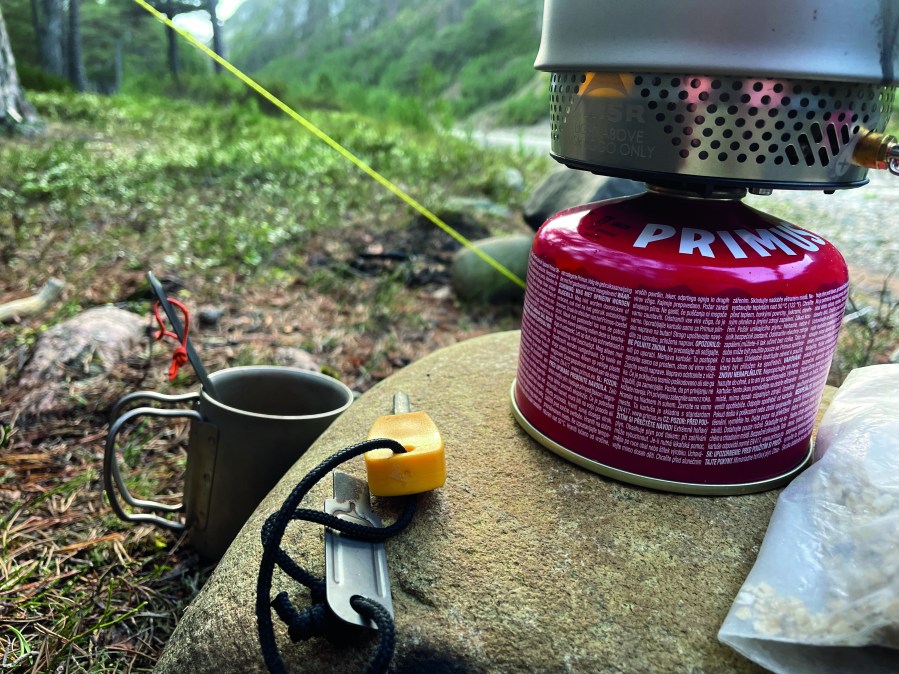
Weights and boiling times were recorded by Peter in various conditions outside and at home to achieve a benchmark time. The stacking systems height includes the plastic feet and a 230g gas canister, the others from canister base to potstand top. The stoves have been used across all seasons, most often on hill days with a wind shield as well as at camp and on bothy trips.
What to look for in camping stoves
Fuel
Butane/propane in canisters is hot, convenient, and clean. Stoves generally have good flame control. Methylated spirits/denatured alcohol/gel fuel doesn’t give out as much heat and flame control is poor. However only the amount needed needs to be carried and it isn’t a petroleum product. Meths stoves are silent too.
Burner Head
Small diameter burner heads are best used with narrow pots. Wider burner heads spread the flame more efficiently and work well with larger pans.
Stability
Stability can be an issue with canister stoves. The simplest – a gas head that screws onto a canister – need a very stable base to counteract the effect of perching a loaded pan on top of a stove, on top of a canister. By contrast, a remote canister stove sits on the ground with its own legs and is attached to the canister by a flexible fuel hose. It has the additional advantage of allowing the canister to be inverted in cold weather or when nearly empty.

Burner diameter
Gas stoves with small-diameter burner heads can create intense burn zones, or hot spots, on cooking pans. Others are wide but work less well with taller, thinner pots. Some stoves come as complete ‘systems’, with exchangers built into the accompanying pan to distribute heat more evenly. Pan materials also matter: thin titanium is prone to hot spots; stainless steel is better; a thick aluminium pan is best at dispersing heat.
Efficiency
Fuel efficiency is a trade-off between weight, speed, size, design and the conditions of use. It’s impacted by ambient temperature, altitude and wind, and is difficult to measure accurately. A heat exchanger pot or a pressure regulator can improve fuel efficiencies. In Britain the most common type of gas canister cartridge is screw-on, and most contain a mix of butane, isobutane and propane. Isobutane has better vapour pressure and offers superior performance, especially in low temperatures. Butane is the cheapest but poorest-performing fuel in the mix.
Gas
Brands will specify their stoves should only be used with their own brand gas canisters. In reality they will work with any canister with a compatible connection (in Britain, the most common type is the screw-on). Virtually all compact cartridges contain a mix of butane, isobutane and propane. Isobutane is far superior in terms of vapour pressure, and high vapour pressure translates to better performance, especially in low temperatures. Isobutane is more expensive to source than butane, so you’ll usually find it in higher-quality canisters. Normal butane is the cheapest and poorest-performing fuel in the mix. Burning efficiency is also reduced by cold temperatures, high altitude and wind.
Windshield
A windshield is needed with every stove in any wind stronger than a light breeze. Some stoves come with windshields as part of the design. Fully encircling foil windshields can be used with remote canister stoves. Canister top stoves shouldn’t be fully surrounded by a windshield as the cartridge needs to be kept cool.
Pans
Camping stoves with small diameter burner heads can create intense burn zones, or hot spots, on cooking pans. Titanium pans have thin bases so are prone to this, stainless steel is better, a thick aluminium pan is best at dispersing heat.
Controls
Stoves may have compact gas control dials, or wire hoops that fold out, which can provide finer control of the flame and reduce the risk of burning fingers or sleeves. Onboard piezo igniters are a nice convenience, but it’s worth carrying a fire steel and/or a lighter in case of failure. Multifuel stoves come with a pump system to fit pressurised fuel bottles.
Many people talk about the ‘Big Three’ when it comes to hiking and camping: that’s your backpack, your backpacking tent and your sleeping bag. For backpacking, we think it’s better to think about a ‘Big Four’ with that extra digit accounting for your cooking system.

Heat Exchanger
Sets of radiator-like fins attached to the base of a pot are designed to reduce heat loss and increase fuel efficiency and boil times. These are provided with some stoves as part of a component system. Heat exchanger (HX) pots can be bought separately.
Regulated and non-regulated canister stoves
Canisters lose pressure as the gas is released. This happens more rapidly in cold weather. Below zero power output can double the time it takes water to boil. If the canister is less than half full water may not boil at all. Keeping the canister warm helps – in your sleeping bag overnight, putting your hands round it for example. A better solution is a stove with a regulated burner that controls the pressure for a more consistent performance. Regulated burners perform better with an almost empty canister though there’s still some drop off in power.
Pre-heat Tubes
A pre-heat tube is a loop of the fuel line that runs over the burner so it is heated by the flame. They are found on some remote cartridge stoves. A preheat tube means the cartridge can be inverted in cold weather to turn it into a liquid feed stove – the liquid turns to gas when heated in the pre-heat tube. Such stoves are excellent in sub-zero temperatures.
Pot Supports
The width and strength of the pot supports determines how heavy a pot they can safely support.
Piezo Ignition
Many stoves have Piezo ignition. This is fine – when it works. Such ignition can easily be damaged so carrying a back-up is a good idea.