
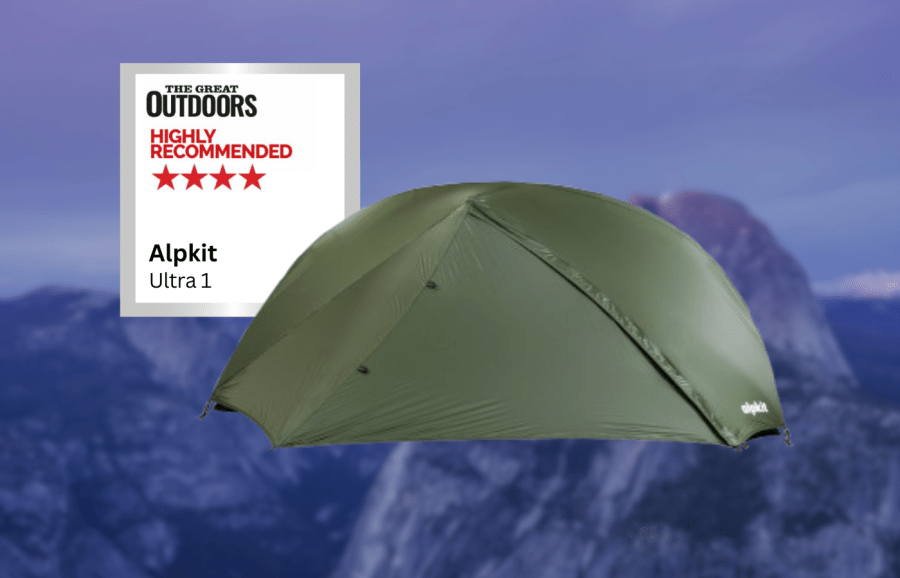
Munroist Fiona Russell goes fastpacking in Knoydart with the Alpkit Ultra 1.
As a slim female, I prefer to keep my pack weight as low as possible, especially for adventures where I hope to move more quickly over the ground. The so called ‘big three’ are the best ways to shave weight – the tent, sleeping bag and rucksack. But there is always a balance to be struck. Lightweight shouldn’t mean flimsy, cold or uncomfortable. The Alpkit Ultra 1 is one of the lightest three-season tents I’ve ever tested.
Fiona Russell highly recommends
The Ultra is well suited to moving fast and light on foot or by bike, but the mesh inner and small living space do means it’s best for 2-3 season use.- lightweight
- waterproof
- head clearance
| Quick Specs |
|---|
| RRP: £299.99 (available from Decathlon) Weight: 900g Features: Semi freestanding; asymmetric; mesh inner plus flysheet; bathtub groundsheet; side-entry porch; internal stash pockets and hanging loop; TPU seam taping; PFC-free face fabric Pitching: Inner first, or outer only Flysheet: 10D Nylon Sil/Sil ripstop/ 1500mm hydrostatic head Inner: Nylon mesh Groundsheet: 15d Nylon ripstop Sil/PU/ 5000mm hydrostatic head Poles: Carbon fibre Pegs 7 x Apex alloy Porches: 1, side entry Inner Dimensions: width 77cm, length 210cm, height 80cm alpkit.com |
It weighs just 900g, although with a stuff sack and bags for pegs and poles this rises to 953g. I also packed a footprint ground sheet – at an extra cost of £19.99 and an additional 134g – to protect the inner floor from rough ground. While lightweight, the Ultra proved to be sturdy and remained stable even in moderately strong overnight winds. There was a bit of fabric flapping, but nothing overly annoying. The outer resisted rain, frost and snow, and while the all mesh inner makes for good ventilation it can equally make for a cool and breezy night!
The tent is erected in two parts – inner and then flysheet – with elasticated carbon fibre poles. Even first time, I managed this fairly swiftly and it required very little adjustment to make the fabric taut. After a little practice, I was able to complete the task in less than 10 minutes. It is a semi-freestanding design, which means you could choose to use only the inner part of the tent and not bother with the flysheet in warmer, bug free conditions.

The asymmetric shape means the internal floorspace is quite roomy. I had a small area of space at the foot of my sleeping mat for storing a dry bag and I also made use of the internal stash pockets for small items. A hanging loop is useful for a headtorch. The small side porch has room for a pack and hiking shoes – cooking in the porch would be a challenge but can be achieved if one is careful.
This is a low tent with little headroom. Inside, I could only just sit up and there is little room for getting changed or moving about. As I said before, there is a balance of weight versus comfort and size.
Alpkit offers a three-year “Alpine bond” that allows you to request repair, replacement or return. There is also a nod to the environment – the tent uses siliconised face fabrics that do not require a DWR coating, so the Ultra is naturally PFC-Free. The Ultra is well suited to moving fast and light on foot or by bike, but the mesh inner and small living space do means it’s best for 2-3 season use.
Testing conditions
Fiona used the tent in Scotland in spring and summer in mixed conditions, for fast-packing trips. She is 5’ 7” / 173cm tall and sleeps cold.